


What are Robot Cards?
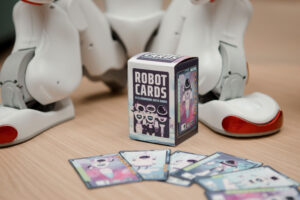
These cards, developed by the Data Education in Schools team, introduce Primary School students to early concepts in statistics and data analysis.
They’re also designed to spark learners’ interest in robotics. We worked in collaboration with the National Robotarium during their development.
Students can use the cards to explore early mathematical concepts such as ordering, before moving on to creating simple graphs like bar charts and scatterplots.
While exploring the cards, students often raise questions of their own: “I wonder how cost relates to size?” or “What factors does a robot’s class affect?” After exploring the cards and taking part in activities, students can then plan an investigation into their own hypotheses.
Robot Cards took inspiration from the Dragonistics Data Cards by Dr Nic at Creative Maths and Stats.
Physical card sets
We’re about to send out our very first physical Robot Card sets! If you’re a teacher in Scotland and would like to receive a set, please fill in this form: Robot Cards – Expression of Interest
Printable cards – downloadable files
Download and print these files to use with your class. The PDF contains 99 cards, and a slide deck is included with suggested classroom activities.
- Getting Started With Robot Cards – Booklet Guide
- Robots – Background
- Robots – No Background
- Lesson Slides (PowerPoint): Robot Cards Slides
We’ve also created a blank Robot Cards template for students to design their own – for example, cards based on real-life robots.
Printing instructions
- Printing with background: print double-sided
- Printing without background: print single-sided
Cross-curricular links
Teachers who’ve trialled the cards in their classrooms have told us they’re useful for other areas of the primary curriculum too. For example, linking to English literacy through books about robots, and encouraging critical thinking about the purpose and role of robots in society.
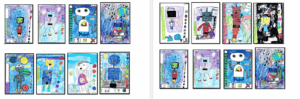
After discovering the Robot Cards, Mairi Stevenson’s P5 class at Lorne Primary decided to create their own, and will explore further into the role each robot plays in helping people and the world.